Social Workers an Integral Part of Hospice Care
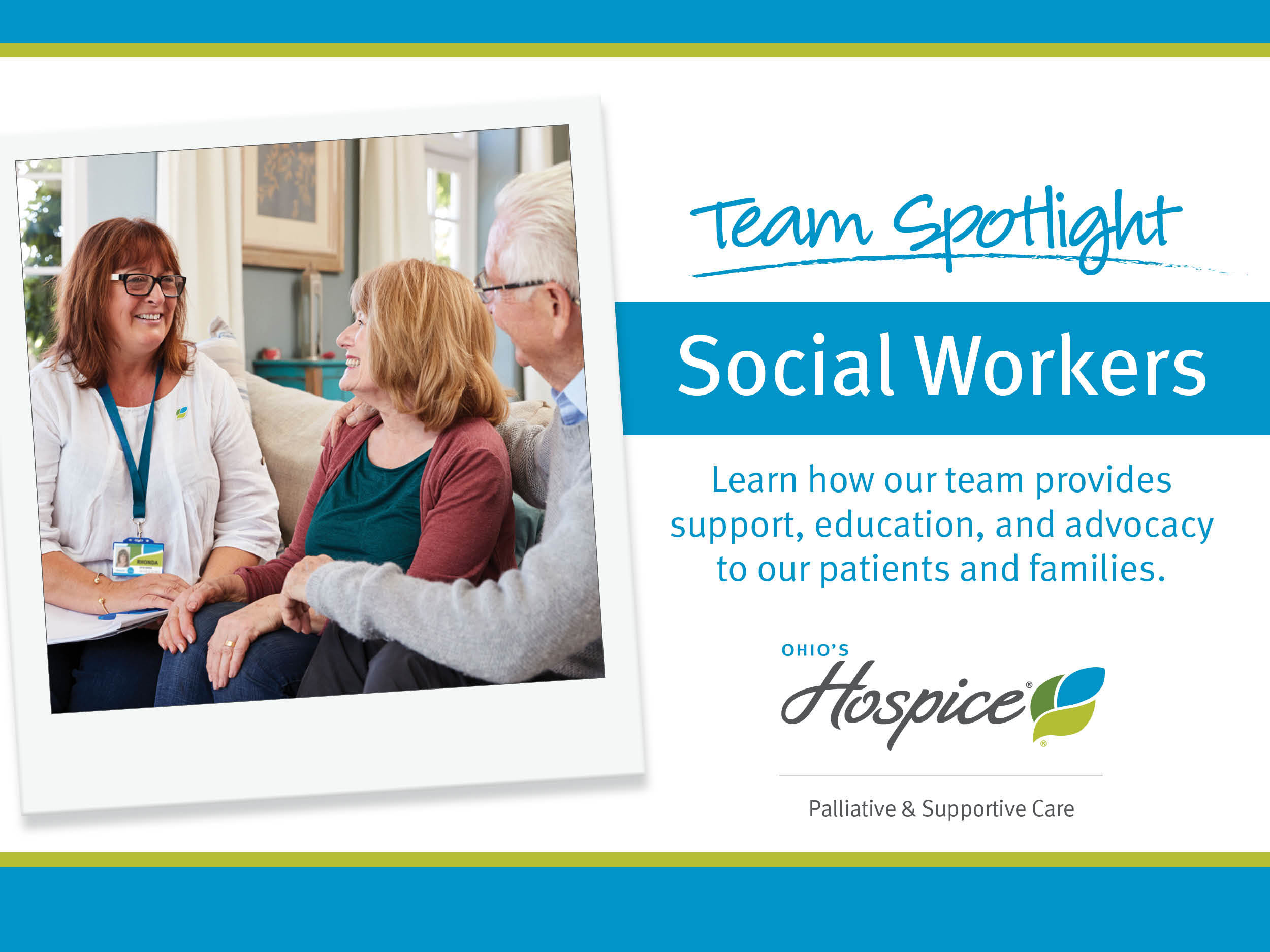
Ohio’s Hospice is proud to provide superior care and superior services to each patient and family.
But that isn’t just limited to medical care. Throughout the state, Ohio’s Hospice employs a team of social workers who provide compassionate care with unwavering dedication.
They are experts who help patients and families prepare for end of life in myriad ways.
Social workers at Ohio’s Hospice:
- Offer visits to provide support for patients and family members processing grief and help them receive education about hospice care.
- Advocate for patients so they and their families can make informed decisions about their care and advanced directives so that their choices are heard.
- Provide education and help find resources for those seeking grief counseling, mental health, substance abuse, trauma, or other therapies.
- Bring knowledge and expertise in working with ethnic, cultural and economic diversity.
- Facilitate family meetings to foster effective communication and decision-making.
- Navigate the complexities of the healthcare system including Medicare and Medicaid options and the application process.
“I think the heart of what we get to do as social workers is really advocate for what the patient wants and sometimes it’s a hard place to be,” said Bonnie Burnside, manager of social workers and chaplains. “We’ve had a couple of really tough cases lately where the social worker has really been doing that.”
In one such case, a patient wanted to die in his place of business as his home was not habitable. He was adamant, but his family and some community members objected because his business was in a public building and they didn’t feel it was safe.
“But you know what,” Bonnie said. “He gets to define what [his death] looks like. Is it how I would have wanted to die? No. But I just feel so proud of our team that we worked so hard for him to be in that environment because that’s where he wanted to be.”
There was another case where a cancer patient believed a miracle was going to happen and he would get better. As his health was declining, the social worker stepped in and made sure that the team focused on the patient’s goal, which was pain management, and not focus on impending death.
“And so that social worker was able to talk [to the team] and say this is about him,” Bonnie said. “And he woke up in the morning and he looked at his wife and he said ‘it’s time to stop praying for a miracle. I want you to let me go.’ And he passed away that afternoon.”
She took the time to ensure that we were informed, comforted, and cared for every step of the way.
– Alyssia McDowell
That situation was emblematic of what our social workers do.
“What we really get to bring to the team is really hearing who that patient is and then like kind of standing in the gap for them to be that person to say ‘this is what they want even if it doesn’t seem like a good idea to you, this is what this is,’ ” Bonnie said.
Hazel Speelman, a social worker in the inpatient units in New Philadelphia and Wooster, is often a liaison between patients and families, making sure the communication lines are always open.
In one such instance, the family of a patient didn’t want Hazel telling their loved one that she was from hospice. At the same time, the patient didn’t want her telling his family that she was from hospice.
“I said, ‘you know, I really think we need to have a family meeting. I know this is the first time you’re meeting me, I really think having an honest conversation with your family is what we need to do at this point,” Hazel said. “And they were a little hesitant, but they were agreeable and you could almost see the weight lifting off of everybody’s shoulders because they weren’t carrying the secret that they all thought they had to carry from each other.”
For Destini Smith, a home-care social worker in Wooster, her focus is pretty simple.
“It’s just whatever that family needs,” she said. “It’s helping them navigate the nursing home and understanding how Ohio’s Hospice is that supportive service. It’s very confusing at times and the families kind of get a little bit lost in the mix because they just don’t know.”
Bereavement counselor Marissa Bryan basically begins her job when mourning starts.
“We have what we call a primary bereaved. [They are] identified by the team and we reach out to each one of those primary bereaved at about a month or two after the loss. We let them know our services, see if there’s anything we can do for them. And then from there they get mailings so they know that we’re still here. That lasts for 12 months and then they get a call at six months from our volunteer department.”
Marissa also offers support groups, workshops and other educational opportunities.
“But my primary duty is just to reach out and support those that have lost a loved one,” she said.
Despite different job functions, all of our social workers also make sure patients and families understand that they are a valuable resource and not someone who is there to disrupt the family dynamic.
“We combat it by letting them know that we are never there to do harm,” Marissa said. “We take an oath, so to speak, that we are truly there to help people. And anything that we do is not meant to harm, it’s meant to help.”
Destini said to get in the door is dependent on how they act at the door.
“I think it’s a lot how you present yourself, you know, when I call my families to get in the door,” she said. “I say, you know, I’m part of the team. I work really close with your nurse to help with goals and to advocate. And I think they’re willing just to let you in and have that conversation because you’re not going in with a checklist, you’re going in to meet them where they’re at.
And then once they meet you, they get to decide how much support they want. And I think putting it back in their lap of understanding that they have control over this really gets us in the doors.”
What we really get to bring to the team is hearing who that patient is and then standing in the gap for them … to say ‘this is what they want.’
– Bonnie Burnside
The work our social workers do does not go unnoticed.
In particular, one of our medical social workers, Jody Holstein, was commended by the daughter-in-law of one of our patients.
In nominating her to receive an award during our Bouquet of Recognition, Alyssia McDowell wrote about Jody’s compassion and understanding of what the family was going through.
“She took the time to ensure that we were informed, comforted, and cared for every step of the way,” Alyssia wrote. “One of the many meaningful gestures Jody provided was capturing our loved one’s fingerprints for the family — a keepsake we will always treasure. Jody was also attentive to the practical and emotional needs of our family. Understanding that children grieve differently, she thoughtfully offered childrens books on grief, helping the youngest members of our family begin to process what was happening in an age-appropriate way. Throughout all of this, Jody carried herself with a gentle, soft-spoken kindness that brought peace to our family. Her presence was calming and compassionate, and her care extended beyond her professional duties — she made us feel seen, heard, and supported in ways we will never forget.”
Alyssia added that Jody “exemplifies what it means to be a hospice social worker. Her dedication, empathy, and humanity reflect the true spirit of hospice care.”
Through engaging conversation around goals of care, advocating for patient rights, counseling, providing education and helping locate meaningful resources, our social workers play an important part in hospice care.
There are also ethical and legal interventions as well as discharging duties for which they are responsible.
Thank you to all of our social workers who continue to support our mission each and every day!