It Takes a Village: Thank You Care Partners
Ohio’s Hospice is a partnership of mission-driven, not-for-profit hospices in Ohio committed to preserving community-based hospices.
This collaboration takes place wherever our patients call home and that is made possible, in part, by our many care partners and referral sources – nursing homes, assisted living facilities, hospitals and myriad health professionals throughout the areas we serve.
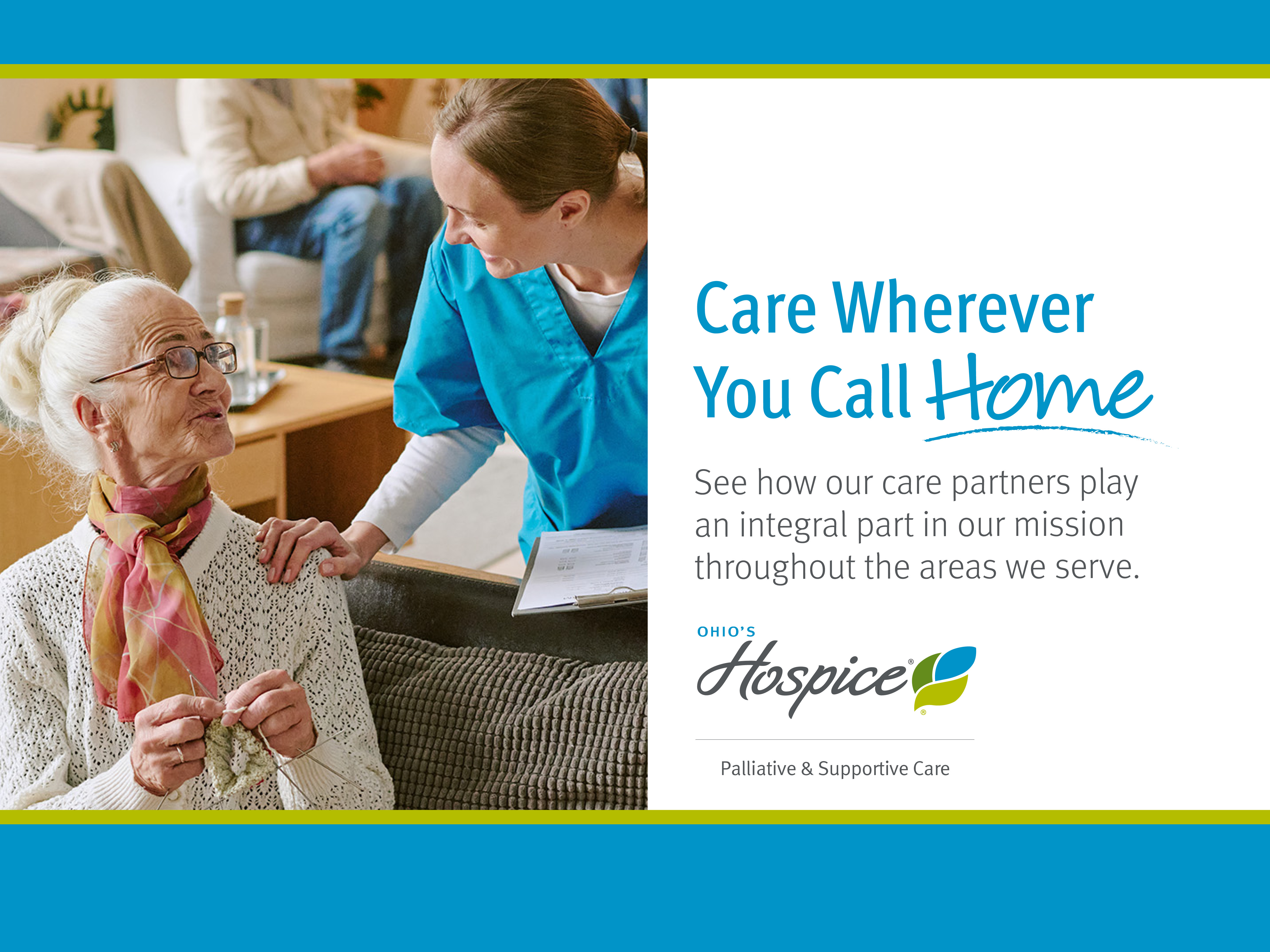
They’re integral parts of our mission of providing superior care and superior services.
“I think their importance is if we aren’t all working together as good partners, I think that the care of the patient and the communication with the family suffers,” said Jonathon Smith, director of business development. “So having a really good balance of talking back and forth to help everybody with every stage of planning is just really a whole lot better and it’s higher quality outcomes for the families.”
At Ohio’s Hospice, we contract with more than 370 nursing homes, enabling us to provide care for patients during life’s most precious moments.
“As people approach the end of their life, their needs significantly change,” Jonathan said. “They need a lot more help doing things. If you are a facility that we work with and your resident changes and needs a lot more care, where do you go to find extra care for that resident? So hospice comes in as a partner to reduce some of the burden on the facility for the care needs because we’re the experts in end-of-life care, symptom management, and pain control. They feel a lot better knowing that we’re available to help out and to assist with that resident.”
Our care is not meant to replace the care already provided at the nursing home, Jonathan said.
“They still want to be there and still want to participate, but without us, it would be significantly more challenging for them to staff appropriately to be able to care for those residents that are passing,” he said.
Because of these meaningful partnerships, previously underserved areas, like Perry County, have increased its hospice engagements. According to Jonathan, in 2010, Perry County had a hospice service ratio of about 3.5 out of 10 patients.
This year, the ratio is around 8.5 out of 10.
“We’ve spent 15 years doing education throughout the community,” Jonathan said. “And we think now that Perry County specifically is better off because [more people] are getting end-of-life care through a hospice provider. I think we all would agree that’s a step in the right direction.”
Those same steps take place in all of the communities in which we are privileged to serve.
“There’s a lot of people that have their hands in [hospice care],” Jonathan said. “That could be our volunteers. That could be one of our staff members. That could be a medical director. That could be one of our liaisons. That could be our nurse who just happens to live next door to somebody [who needs care]. It could be our chaplain who’s preaching at a church on a Sunday and somebody asks him about it just because they know that he is affiliated with the organization. That stuff does regularly happen. I think it’s a whole community approach at making sure that people get end-of-life care.”